When an Institution Changes Its Rules but Not Its Routine
Understand why institutional rules can change while routines persist, and compare ways to make written expectations visible in everyday decisions.
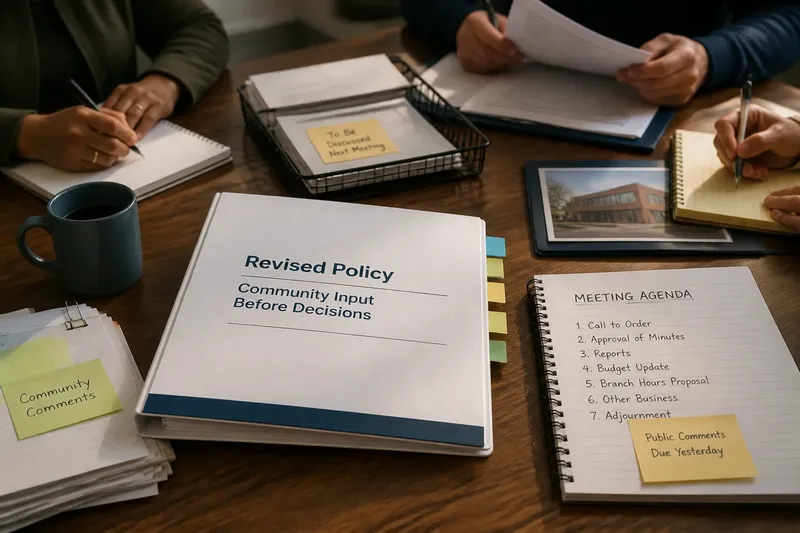
An institution can revise its rules and still make the old routine the easiest choice. A new policy may call for public input, for instance, while meeting agendas, staff roles, and decision deadlines continue to leave little room for it. The difference between written expectations and repeated practice is where formal change often stalls.
That gap is not simply a matter of people ignoring a document. Routines are carried by calendars, forms, handoffs, habits, and assumptions about what counts as a reasonable decision. To understand what a rule change has accomplished, compare several ways to bring the written expectation into daily work—and choose one that fits the institution’s actual bottleneck.
Rules set expectations while routines allocate attention
A rule states what should happen or what is allowed. A routine is the familiar sequence people use to get through work: who prepares a file, which questions are asked, what gets deferred, and who is expected to approve the result. The routine may never appear in a policy manual, yet it shapes the practical meaning of the rule.
Consider a committee whose revised charter invites community comments before decisions. If the agenda is still distributed after comments are due, the invitation exists on paper but does not shape the committee’s discussion. The rule and routine are both real; they simply organize different parts of the process.
This distinction matters because visible compliance can coexist with unchanged practice. An institution may publish the revised language, hold a launch meeting, or add a new form without changing who speaks, what information reaches decision-makers, or when a choice becomes difficult to reverse. Those details reveal whether the new expectation has entered the working sequence.
Three approaches connect a formal change to daily work
There is no single remedy for every gap. The useful question is whether the obstacle lies in unclear interpretation, a process that still rewards the old behavior, or an absence of feedback about what happens after adoption.
Clarify the rule at the point of decision
This approach turns broad language into shared expectations at the moment people act. A short decision guide, a revised agenda template, or a standing prompt in a review form can explain what the rule requires and what evidence should be considered.
It suits institutions where staff and members agree that change is needed but interpret the new wording differently. It is less useful when the old process leaves no time or authority to follow the clarified expectation; clearer directions cannot create capacity that the workflow does not provide.
Redesign the routine that carries the rule
Here, the institution changes the sequence of work so the new expectation has a practical place. That might mean moving a consultation deadline before agenda preparation, assigning someone to summarize responses, or requiring the relevant material to travel with a proposal through review.
This approach suits a rule whose meaning is understood but repeatedly arrives too late to influence action. It asks more of the people who maintain the process, and it can expose dependencies that a policy revision left untouched. The aim is not to add ceremony; it is to make the expected action part of the ordinary route.
Review practice and revise the implementation
A review approach examines a sample of actual decisions, meeting records, or completed files, then compares the observed sequence with the written expectation. The review should ask what made the expected action possible or difficult, rather than treating every departure as individual defiance.
This suits institutions where practice varies by team or where leaders lack a clear account of how the rule is being used. It can help distinguish a training need from a process flaw, but it requires a credible way to discuss findings and make adjustments. Without that response, review becomes another record of the gap.
Choose the approach that matches the bottleneck
Start with the point where the new expectation should alter a decision. Then ask whether people know what to do, whether the routine gives them a chance to do it, and whether anyone can tell if it happened. The answer points toward clarification, redesign, or review.
- Choose clarification when people describe the rule in conflicting ways but the workflow can already accommodate it.
- Choose redesign when people understand the rule yet the relevant information or action arrives too late.
- Choose review when accounts of practice differ, or when the institution cannot identify where implementation breaks down.
Say a fictional library board adopts a rule requiring neighborhood feedback before changing branch hours. If staff agree on what counts as feedback but receive it after the schedule proposal is prepared, the board could move the feedback deadline earlier and attach a response summary to each proposal. The observable result to look for would be whether the summary appears in the decision materials and whether members discuss it before choosing a schedule.
Sometimes one approach reveals the need for another. A review may show that the rule is interpreted inconsistently; clarification then makes sense. If the meaning is already shared but the handoff fails, redesign is the more direct choice. Avoid selecting a visible intervention just because it is easy to announce.
What should you look for after a rule changes?
How can you tell whether a routine has changed?
Look at the sequence of ordinary work, not only the policy text or launch materials. Meeting agendas, decision records, forms, and handoffs can show whether the new expectation appears before choices are settled.
Why do staff keep using an old process?
The old process may be familiar, easier to coordinate, or supported by tools and deadlines that remain in place. A useful response identifies which part of the work sustains it instead of assuming that repeating the new rule will resolve the problem.
Should every departure from a new rule be treated as resistance?
No. A departure can reflect a misunderstanding, a conflicting requirement, missing capacity, or a routine that was never updated. Find out what shaped the decision before deciding what kind of response is appropriate.
When should an institution revisit the written rule?
Revisit it when the wording is ambiguous, conflicts with other expectations, or proves impractical under the conditions people must work within. If the rule is clear and the obstacle is a late handoff or an unchanged agenda, revising the process may address the gap more directly.
Keep the written expectation visible in ordinary decisions
A rule becomes consequential through the places where people encounter it: the agenda item, the approval form, the briefing note, or the moment a proposal is revised. Keep the expectation close to those decisions, and give someone a clear role in maintaining the relevant materials.
To judge whether an institution has changed its rules but not its routine, compare a recent decision with the sequence the rule calls for. That simple comparison makes the institutional gap concrete: it shows what was expected, what happened, and which part of the working process may need attention next.